STELLAR CONSENSUS PROTOCOL (SCP)
An architectural breakdown of quorum intersection, the threat of network splits, and the mechanics of instant transaction settlement.

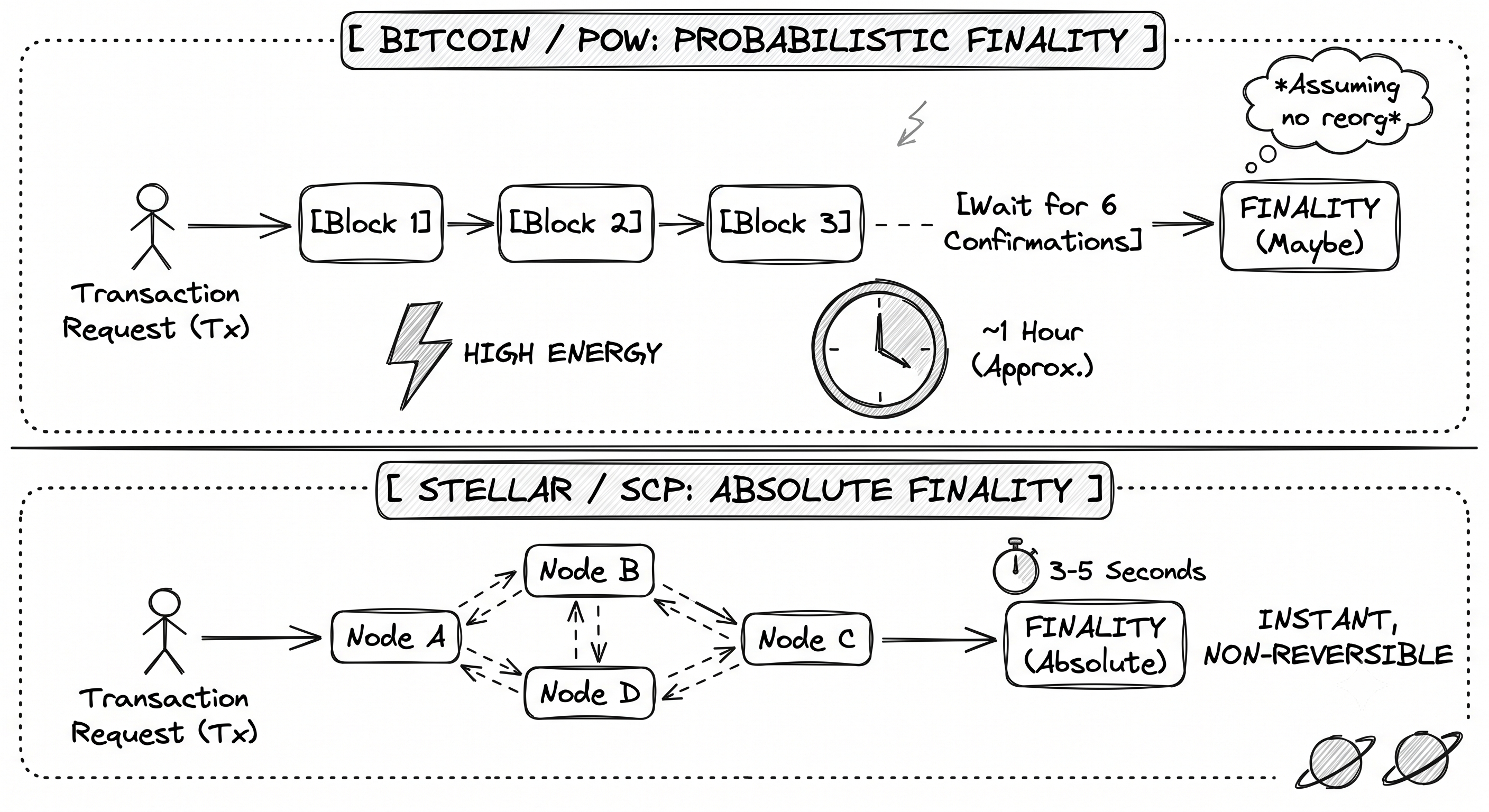
When I was going through Stellar's mechanism, I noticed exactly what you pointed out: it works very differently than Bitcoin or any other traditional blockchain-based system. To really understand the magnitude of this difference, we have to look deeply into the mechanics of both sides. Systems like Bitcoin (and historically Ethereum, though it recently shifted away from this model specifically to address the energy concerns you mentioned) work on Proof of Work. This is a system where a miner essentially mines for the network by tackling a mathematical expression which is incredibly hard to solve but very easy to verify.
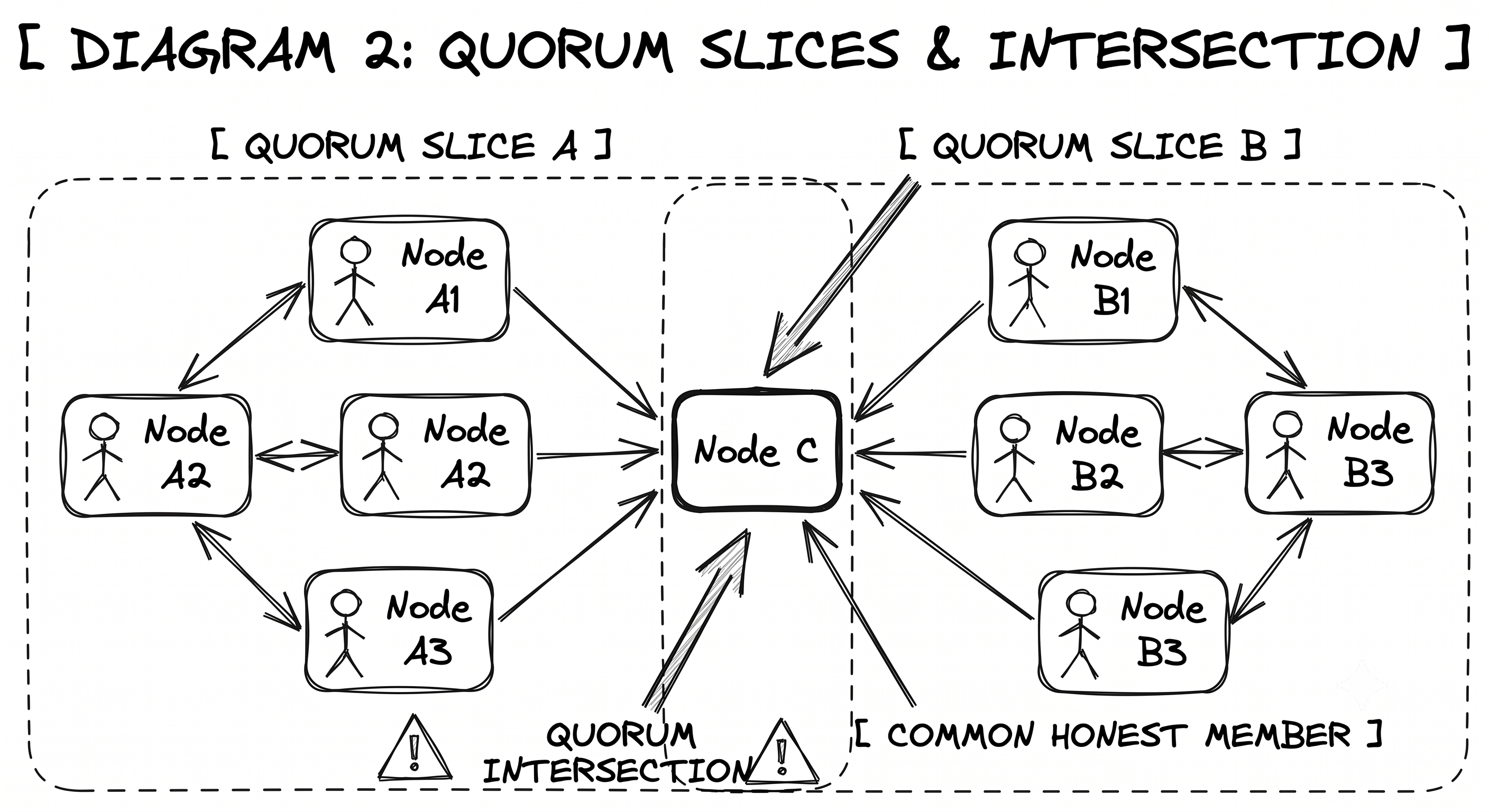
This expression is later used to verify the transaction, and the miner gets a reward for this mining. But Stellar works on a completely different foundation known as the Stellar Consensus Protocol (SCP). Instead of relying on raw computational competition, it relies on agreement. Other nodes convince a node to take a "slice" of trust, and afterwards, those nodes approve the decision and validate it. These nodes create a group that agrees on a decision, and if there are two groups who are completely in favor of another decision, it creates a split. To solve this problem, there must be a common honest member in each group so that they can get to a mutual decision.
As a writer diving into this, let’s expand on exactly how this structural shift changes everything about how the blockchain operates, from its speed to its environmental footprint.
The Exhausting Race of Proof of Work
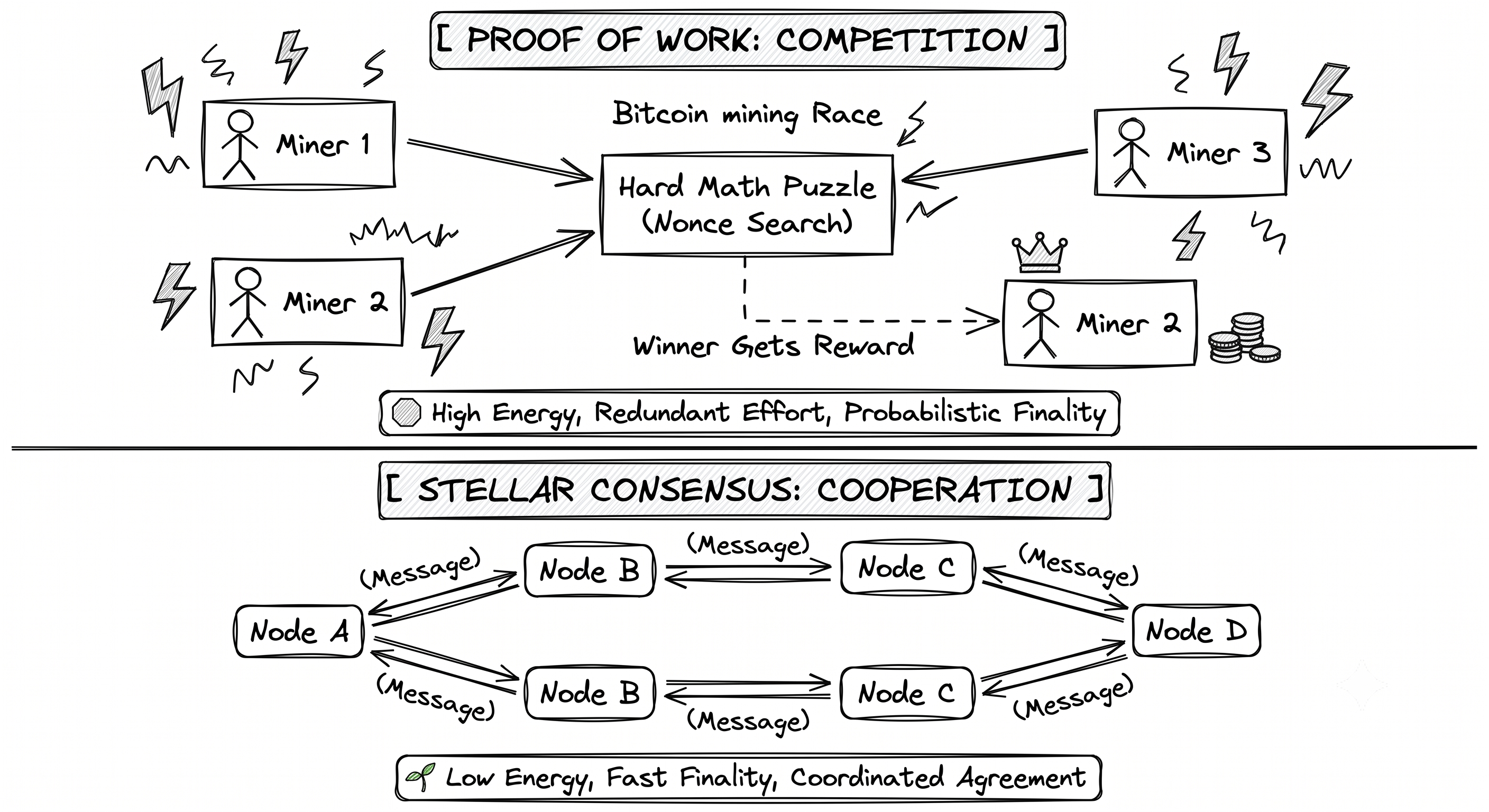
To appreciate the elegance of Stellar’s mechanism, we first have to look at the brute-force nature of Proof of Work. When a miner tries to solve that mathematical puzzle, they aren't using logic or advanced mathematics; they are using raw processing power to guess a random number millions of times per second. Imagine a global lottery where every computer is frantically buying millions of tickets every second, hoping to be the one holding the winning numbers when the draw happens.
Because the mathematical expression is hard to solve, many computers run simultaneously to get the puzzle solved faster. But here is the catch: no matter how much energy is spent by the millions of computers participating in this race, only the one who gets it first gets the reward. The moment that single winning miner verifies the block of transactions and claims the cryptocurrency reward, the work of every other computer on the network is instantly discarded.
This creates a massive redundancy. The system is intentionally designed to be difficult and energy-intensive because that burned energy is what proves the network is secure. If someone wanted to hack Bitcoin, they would need to buy enough computers and electricity to outpace the combined processing power of the rest of the world. While this makes the network secure, it is incredibly slow and consumes as much electricity as entire small countries.
The Shift to Cooperation: The Stellar Consensus Protocol
Stellar steps away from this competitive race entirely. Instead of making computers fight to solve a puzzle, the Stellar Consensus Protocol asks them to talk to each other.
In SCP, there is no mining, and there is no mathematical puzzle to solve. Instead, it relies on a concept called Federated Byzantine Agreement. In this system, each node on the network chooses a specific set of other nodes that it considers trustworthy. This customized list of trusted peers is what we call a quorum slice.
Think of it like a group of professionals making a business decision. You might not trust the opinion of every single person in the world, but you trust your accountant, your lawyer, and your business partner. If those three people agree that a financial transaction is legitimate, you will approve it. In Stellar, a node essentially says, "I will approve and validate this transaction if the nodes in my slice also approve it."
Preventing the Split: The Power of the Honest Member
Because every node chooses its own slice, these slices naturally overlap. Node A trusts Node B and C. Node B trusts Node C and D. Because of this overlapping trust, the individual slices merge together to form a broader quorum—a large group that can agree on a decision network-wide.
But as you rightly pointed out, this creates a vulnerability. What happens if the network gets divided? Imagine one group of nodes is completely in favor of approving a transaction, while another group of nodes is completely in favor of a conflicting transaction (like someone trying to spend the same digital money twice). If both groups finalize their different decisions, it creates a "split" or a fork in the network. The blockchain would divide into two alternate realities, ruining the system's integrity.
To solve this problem, SCP relies on what is mathematically known as quorum intersection. This is the requirement that there should be a common honest member in each group. Because these slices overlap organically, Group A and Group B will inevitably share certain trusted nodes in the middle.
An honest node operates by one strict rule: it will never agree to two conflicting statements. Therefore, when Group A and Group B try to finalize their opposing decisions, they both need that common honest member to reach their final agreement. That honest member will only validate one version of the truth. By doing so, it forces both groups to reconcile and get to a mutual decision. The overlapping web of trust acts as a glue that keeps the entire global network moving forward on a single, unified chain of history.
The Real-World Impact: Speed, Security, and Energy
The results of this architectural difference are profound.
First, the SCP mechanism is much faster as compared to other blockchain-based mechanisms. Because nodes don't have to wait 10 minutes for a computer to guess the right answer to a mathematical puzzle, they can process transactions almost instantly. The nodes simply send rapid-fire messages back and forth to their slices, confirm the decision, and validate it. A transaction on the Stellar network typically settles in just 3 to 5 seconds.
Second, it provides a different, highly resilient form of security. In a Proof of Work system, security is tied to wealth—if someone is rich enough to buy the most computing power, they can theoretically attack the network. In Stellar, security is tied to reputation. You cannot simply buy your way into a quorum; other nodes have to choose to include you in their slice.
Finally, and perhaps most importantly for the future of technology, this mechanism helps in saving lots of energy. Because there are no massive server farms running simultaneously at maximum capacity to win a reward, running a Stellar node requires very little electricity. It can run on standard hardware without drawing massive amounts of power from the grid. By trading a competitive cryptographic race for a cooperative web of trust, Stellar achieves a fast, secure, and environmentally sustainable way to process global transactions.